
March 9, 2026 · From Tom's Substack
A Video Game, a Postcard, and a Grandmother
What if one of the most promising treatments for reducing the intrusive thoughts after trauma involved 20 minutes of playing Tetris? It sounds improbable. But a new randomized trial in The Lancet Psychiatry suggests that a simple visual…

Dr. Tom Insel
3 min read
What if one of the most promising treatments for reducing the intrusive thoughts after trauma involved 20 minutes of playing Tetris?
It sounds improbable. But a new randomized trial in The Lancet Psychiatry suggests that a simple visual puzzle game—played while briefly recalling a traumatic memory—can dramatically reduce intrusive post-traumatic thoughts.
The explanation may lie in how the brain processes imagery. Traumatic memories often return as vivid visual experiences. But when the brain is simultaneously engaged in a demanding visual-spatial task—like rotating the falling blocks of Tetris—it appears to interfere with the brain’s ability to replay those images.
In other words, the visual puzzle may compete with the memory itself.
Like falling blocks in a game of Tetris, intrusive memories can lock into place unless something interrupts the pattern.
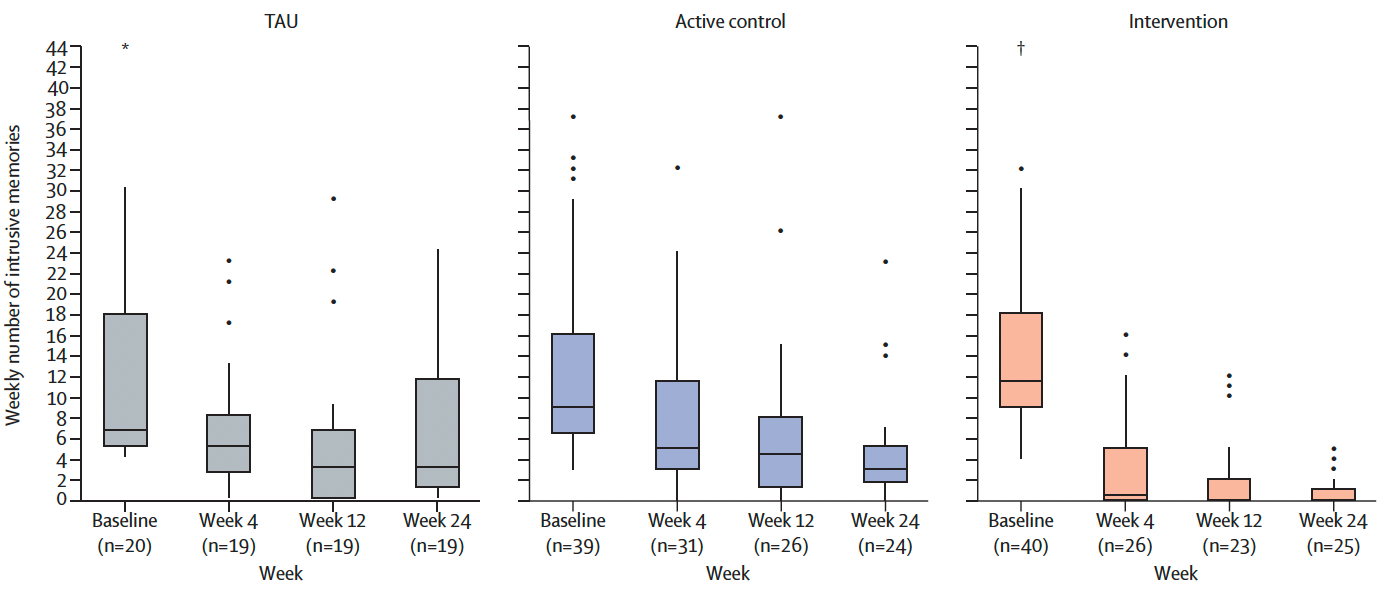
In the study, researchers led by Emily Holmes at Uppsala University tested what they call an imagery-competing task intervention.(ICTI) Healthcare workers who had experienced intrusive memories following the COVID-19 pandemic were randomly assigned to one of three groups: the Tetris-based intervention, listening to Mozart as an active control (active control), or treatment as usual (TAU).
After four weeks, the results were striking. While intrusive thoughts were reduced over time in every group, participants in the Tetris group reported about 70 percent fewer intrusive memories than those in either control groups. Many reported no intrusive memories at all by later follow-ups. And this improvement followed a single guided session delivered remotely.
For anyone used to the slow progress and small effects of psychiatric treatments, these results feel almost suspiciously large. But the Tetris result may not be an anomaly.
It may be part of a pattern.
Over the years I’ve kept a mental playlist of studies showing large clinical effects from surprisingly simple interventions.
Last year a team from Shandong University reported that providing hearing aids to older adults with hearing loss produced improvements in mood surpassing anything I’ve seen in the research literature with antidepressant medications.
Another recent study involving more than 80,000 users found that a single session of app-delivered hypnosis significantly reduced stress. If you had proposed hypnotizing tens of thousands of people through a smartphone app a decade ago when I was funding research at the NIMH, you’d have never made it to review.
Global mental health offers another striking example. In Zimbabwe, the Friendship Bench program trains grandmothers to deliver structured problem-solving therapy on simple wooden benches in community settings. A randomized trial published in JAMA showed profound reductions in depression and anxiety.
Psychologist Jessica Schleider, a leader in the development of single-session interventions, has pioneered “micro-interventions” - brief digital exercises designed to shift thinking patterns. Her book, Little Treatments Big Effects, is the bible for this emerging field.
None of this is entirely new. Or entirely digital.
When I was in psychiatric training fifty years ago, during an era dominated by long-term psychoanalysis, psychiatrist Jerome Motto at UCSF taught us about a high impact intervention that seemed almost quaint: sending periodic postcards to people at risk for suicide. The messages were simple check-ins—small reminders that someone remembered and cared. While a recent randomized trial of this technique revealed less dramatic effects than Dr. Motto reported (who sends postcards in 2026?), the costs and risks were almost negligible.
Different settings. Different mechanisms.
But the same underlying principle appears again and again: small interventions can interrupt destructive patterns before they settle into place.
When people talk about innovation in psychiatry, the conversation usually turns to breakthroughs—new medications, neuromodulation, perhaps psychedelic therapies.
These advances matter enormously. Interventional psychiatry is opening important new pathways for treating severe mental illness.
But there is another frontier emerging alongside it.
A frontier of small, scalable interventions—approaches that can be delivered digitally, in communities, or in brief encounters that reach thousands or even millions of people.
The lesson from the Tetris experiment—and from hearing aids, friendship benches, postcards, and digital micro-interventions—is that progress in mental health care does not always require complexity.
Sometimes it requires finding simple things that work and making sure they reach the people who need them.
Sometimes, like a well-placed piece in a game of Tetris, progress comes from placing the right small intervention at the right moment—interrupting a harmful pattern before it locks into place.
If you know other “little treatments with big effects” validated and replicated in randomized clinical trials, please share.