
October 6, 2025 · From Tom's Substack
Some Elder Thoughts on Youth Mental Health
When I talk about the public health challenges in behavioral health, I usually start with a familiar trio: serious mental illness, substance use disorder, and youth mental health. An individual can suffer from all three, but from a public…

Dr. Tom Insel
4 min read
When I talk about the public health challenges in behavioral health, I usually start with a familiar trio: serious mental illness, substance use disorder, and youth mental health. An individual can suffer from all three, but from a public health perspective, their causes—and therefore their solutions—are different. The crisis in serious mental illness is a care crisis. The crisis in substance use disorder is a crisis of lethality. But the youth mental health crisis? That’s something altogether different.
Everyone seems to agree that “the kids are not okay.” What no one agrees on is why—or even whether we should call it a crisis. The CDC data are clear: since 2000, suicide deaths among youth have risen by 52 percent; for girls, emergency room visits for suicidality have doubled. In the CDC’s latest Youth Risk Behavior Surveillance (2023) report, 40 percent of high school students reported persistent sadness and hopelessness, 28 percent reported poor mental health, one in five seriously considered suicide, and nearly one in ten attempted it. The pattern is clear: more internalizing than externalizing symptoms, more girls than boys, and LGBTQ youth at the highest risk. COVID-19 poured fuel on an already spreading fire.
Unlike our crises in SMI or addiction—both largely American—the youth mental health crisis is global. And the rise in youth distress is hardly unique to mental health: rates of food allergies, pre-diabetes, and even cancer are up. Theories abound: social media, sleep deprivation, climate anxiety, microbiome shifts, economic precarity, reduced stigma, or the pathologizing of adolescent angst. But despite the speculation, the data are thin. Ongoing studies like TECHWISE may help, but for now, we simply don’t know which of these forces matter most—or how they interact.
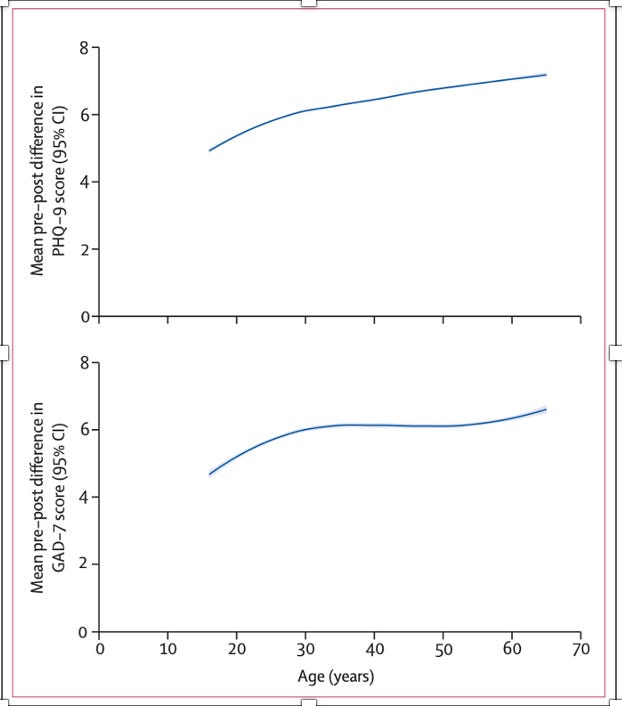
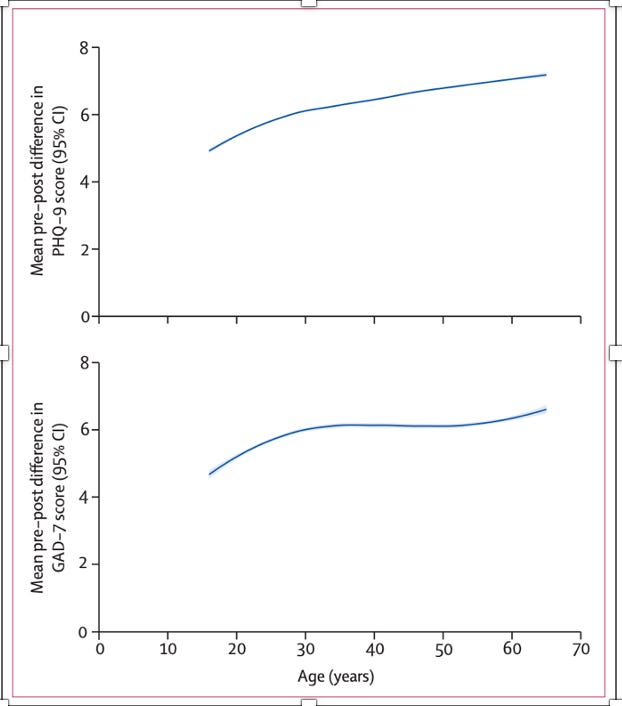
Until recently, I would have offered reassurance: we may not know the causes, but we know what works. After all, cognitive behavioral therapy (CBT) has decades of evidence as the gold standard therapy for anxiety and depression. But a new paper in Lancet Psychiatry has shaken that confidence. The study analyzed outcomes for 1.5 million people treated for anxiety or depression through the UK’s Talking Therapies program—the world’s largest implementation of evidence-based psychological care. The results? You can see in this figure from the paper that for people under 30, the results were not as good for depression (PHQ-9) or anxiety (GAD-7). Yes, kids did indeed improve overall but as the authors state, “Young adults experienced a smaller change in symptoms pre–post treatment and had between 17% and 26% lower odds of reliable recovery and reliable improvement.” And youth were significantly more likely than adults to report deterioration in symptoms. The gold standard didn’t glitter so brightly for the young.
These new results from the clinic remind me of recent reports on universal interventions for youth. Lucy Foulkes and others have reported on the negative effects of some of our school mental health efforts. Mindfulness delivered to all early adolescents in a school setting shows surprisingly weak beneficial effects and even harmful effects in some. One way to read this emerging literature is that kids are not little adults – we can’t assume they will respond the same way to interventions developed for adults. My take is a little different. Reading the reports of negative responses in children and youth, I am struck by the way in which CBT and mindfulness training make kids with internalizing disorder more “internalized”.
Maybe the answer isn’t more therapy, but a focus on more normative development. Erik Erikson taught us that every stage of life poses a developmental challenge: industry versus inferiority (tweens), identity versus role confusion (adolescents), intimacy versus isolation (young adults). Now imagine growing up with seven hours of daily screen time (inferiority), psychiatric labels where once there were growing pains (role confusion), and friendship filtered through devices (isolation).
We talk endlessly about treatments, but barely mention the basics needed for healthy development: sleep, community, and purpose are three that need our attention. Nearly half of U.S. high school students report getting less than 7 hours sleep and nearly 80% get less than 8 hours sleep each night. Face-to-face community has been replaced by digital companionship through games, videos, and Instagram posts. Young people are encouraged to get help, but rarely to give it—though research shows that helping others may be even more therapeutic than receiving care. And we vastly underestimate the mental health power of purpose. A meta-analysis in Child Development found that community service—especially when paired with reflection—has a profound effect on adolescent well-being. Yet there’s no billing code for “give a kid something meaningful to do.”
Decades ago in his book on Adolescence, the British psychoanalyst James Anthony wrote, “Society gets the type of adolescent that it expects and deserves.” Perhaps we expect too little. Maybe our rush to diagnose, treat, and medicalize ordinary distress has crowded out the harder but healthier path: expecting responsibility, engagement, and contribution. If the new data tell us anything, it’s that the solutions for youth mental health won’t be found only in clinics. They may be found in bedrooms, classrooms, and communities—where sleep, friendship, and purpose quietly do their developmental work.
Sometimes the hardest part isn’t finding new treatments. It’s remembering the old truths about what helps young people grow up.